
What is Afrofuturism?
Afrofuturism is an interdisciplinary cultural and intellectual movement that merges art, science fiction, technology, and African diasporic traditions. In recent years, Afrofuturism has gained global mainstream popularity with examples including the Black Panther films and comics, pre-eminent authors Octavia Butler and Zora Neale Hurston, and the Smithsonian Museum’s Afrofuturism exhibition.
Watch the video to hear from AFW founder Dr. Porchia Moore and explore resources below.
Hearing Afrofuturism
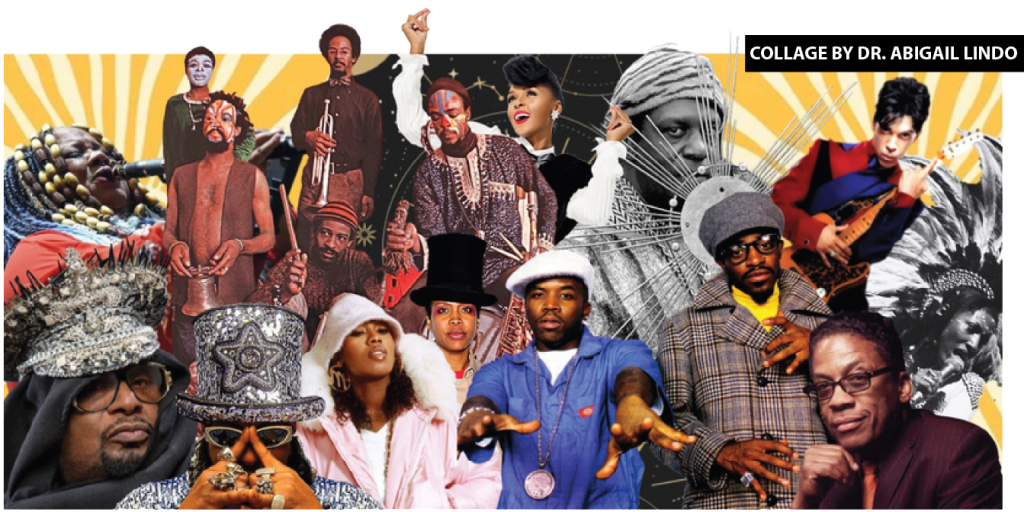
You have always heard Afrofuturism, whether you knew it or not…
Afrofuturism is present as sound in the voices of writers, scholars, and creatives. It has been more pronounced as a sonic reality when watching films and listening from the mid-20th century onward, a key aspect of articulating Black life and imaginaries of and beyond present and past realities of African American lived experience. As a philosophy and cultural aesthetic, Afrofuturism engages subjects from science fiction and fantasy to technological developments and Black ancestrally. It enables experiences of empowerment in the articulation of new realities and liberated futures. Music has played a significant role as a medium for Afrofuturism. When a 21-year-old Gil Scott-Heron released the song “The Revolution Will Not Be Televised,”breathing new meaning into a phrase only uttered in Black militant circle, those who heard it heard Afrofuturism. When Diana Ross and Michael Jackson sang “Ease on Down the Road” in the 1975 Broadway musical The Wiz, a soulful reimagining of the film The Wizard of Oz, audience members heard Afrofuturism.
When Reverend Martin Luther King Jr. professed his dream to over 250,000 Americans in support of civil rights on the steps of the Lincoln Memorial in Washington D.C. in 1963, all in attendance and all who continue to experience his message are hearing Afrofuturism. These three instances, varying in context and impact, demonstrate meaningful moments of Black utterance in media, captured as singular moments of performance though their value is understood in their ability to transcend their technological mediums to affect change. They communicate Afrofutures and have inspired a wealth of creatives and resulting artworks and experiences. These are just three examples, but numerous songs carry their spirit of reclaiming narratives of Afrodiasporic agency, identity, and liberation.
Dr. Abigail Lindo
Enjoy this playlist of music by artists who sonically shaped Black imaginaries and futures using fantasy, spirituality, technology, and science fiction.
Reading Afrofuturism
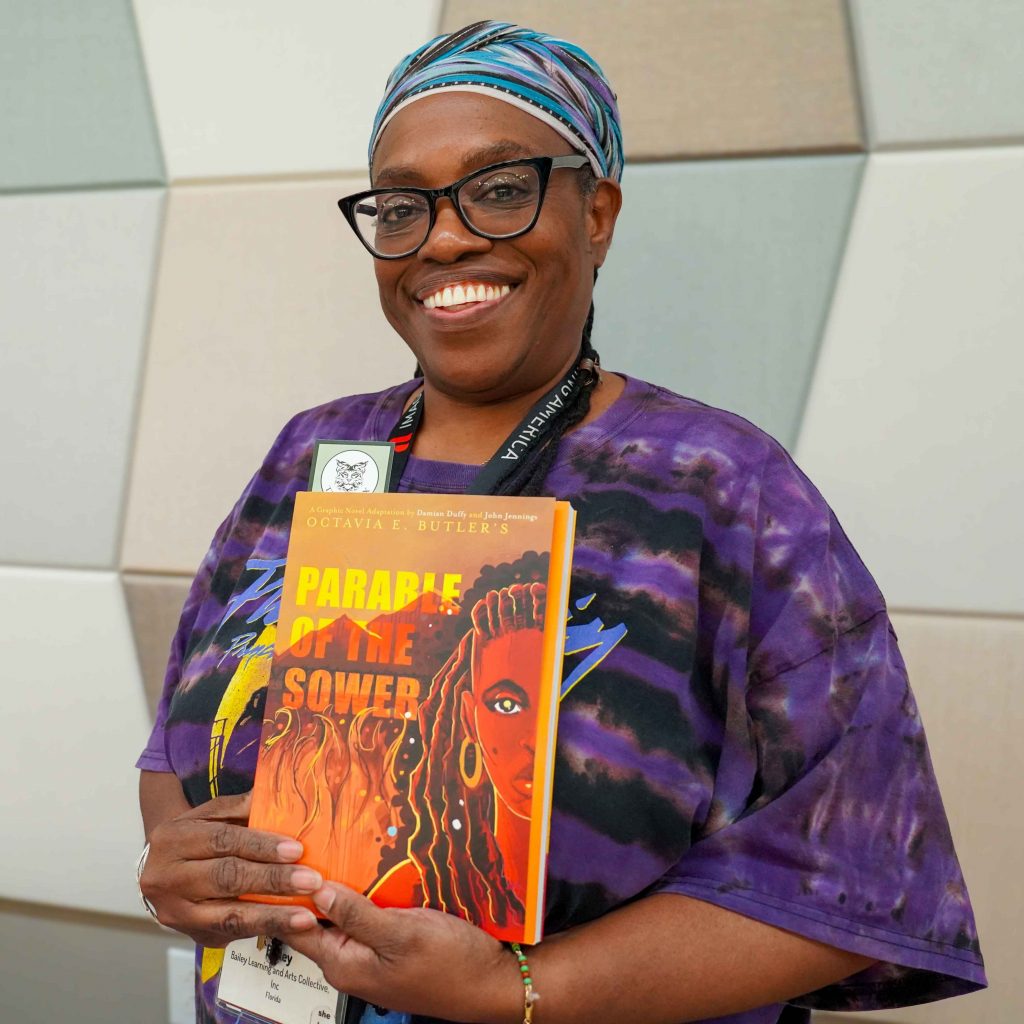
Afrofuturism exists as a sensational reality, often understood through visual art and sound, but its roots lie in literature. In various books, authors like Octavia Butler, Amos Tutuola, and Zora Neale Hurston wrote with the future in mind to shape what would later be called Afrofuturism. Science fiction emerges as a dominant idiom of Afrofuturist writing in the mid-to-late 20th century.
Peruse the list of recommended literature compiled by AFW committee members below.
Literature
Legendborn by Tracy Deonn
Kindred by Octavia Butler
Binti: the Complete Trilogy by Nnedi Okorafor
The City We Became by N.K. Jemisin
The Intuitionist by Colson Whitehead
Dhalgren by Samuel R. Delaney
Riot Baby by Tochi Onyebuchi
Children of Blood and Bone by Tomi Adeyemi
Brown Girl in the Ring by Nalo Hopkinson
Technology, Science, Culture
Afrofuturism by Ytasha Womack
Afrofuturism 2.0 by Reynaldo Anderson The Dark Fantastic by Ebony Elizabeth Thomas
In Search of the Black Fantastic by Richard Iton
Algorithms of Oppression by Safiya Umoja Noble
Distributed Blackness: African American Cybercultures by André Brock Jr
Intersectional Tech: Black Users in Digital Gaming by Kishonna L. Gray
Technoskepticism by The Disco Network
Graphic Novels and Comics
Octavia Butler’s Parable of the Sower Graphic Novel by Damian Duffy and John Jennings
Matty’s Rocket by Tim Fielder
Black Panther: A Nation Under Our Feet by Ta-Nehisi Coates, Stan Lee
I Am Alfonso Jones by Tony Medina and John Jennings
Black Kirby by John Jennings and Stacey
Robinson Black Panther Marvel Collection by Various Authors